The Scale of Arrival
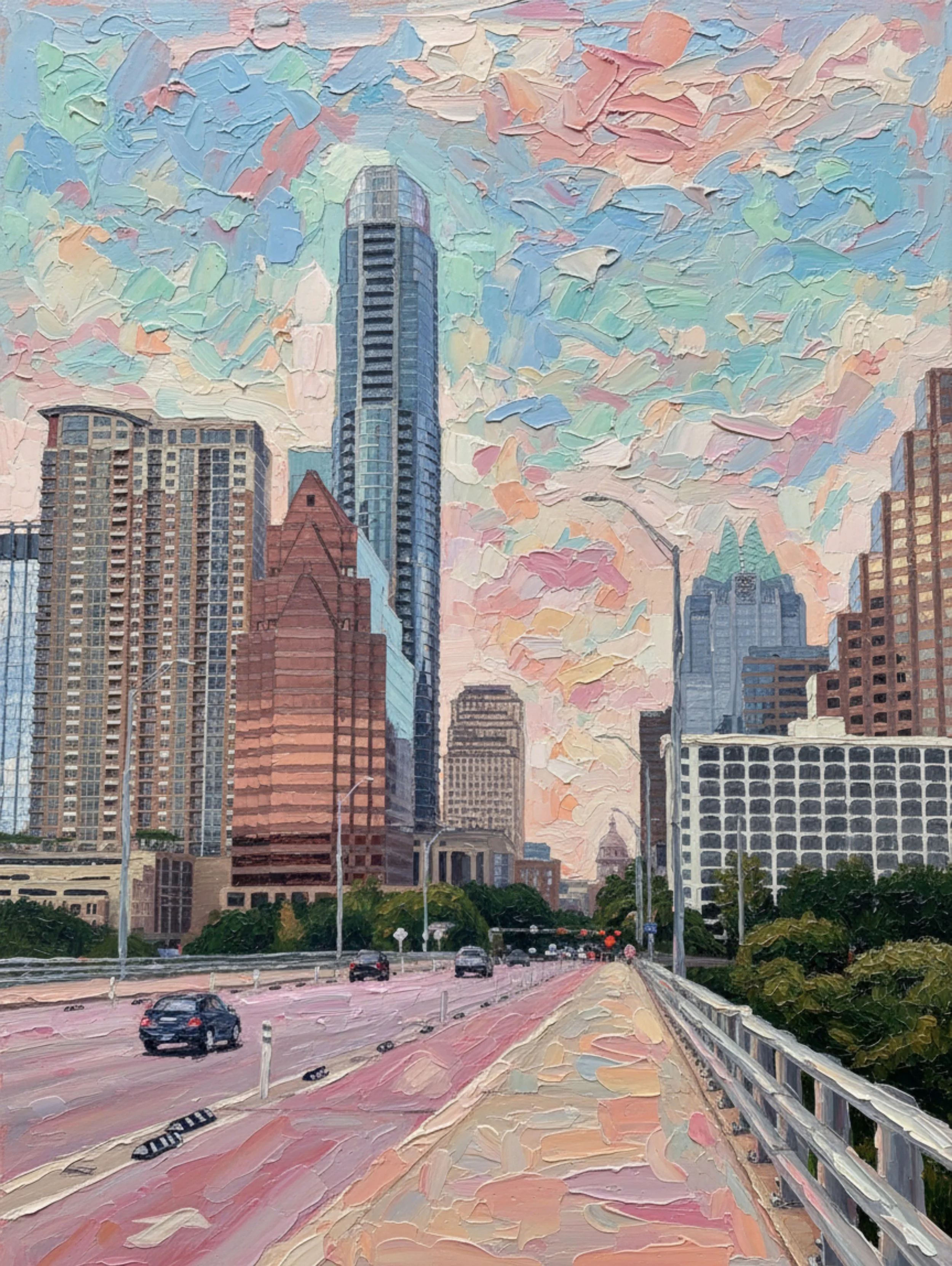
congress street bridge view of capital and skyline
The Horizon Shift
Back in Michigan, my world moved horizontally, defined by quiet country roads, low tree lines, and an unhurried, deeply human scale. When I walk across the Congress Avenue Bridge here in Austin and look up the street, the skyline is anchored by a massive, soaring dome. Seeing the Texas State Capitol from a distance is a daily reminder of a bizarre historical echo. The very same architect from Detroit—Elijah E. Myers—designed the modest, stately white sandstone capitol I left behind in Lansing. But here in Texas, his original blueprint was radically super-sized. Made of native Sunset Red Granite that literally glows like embers in the late afternoon sun, it stands at an impressive 302.64 feet, making it nearly 15 feet taller than the national Capitol building in Washington, D.C. It was a structure so vast it was commissioned by trading three million acres of public Panhandle land to its builders. It was my very first hint that everything I knew about scale was about to shift.
The Glass Matrix
When you look out over the buzzing downtown district, the skyline is an absolute matrix of massive, modern skyscrapers. To the left sits Block 185—the instantly-iconic Sail Building leased entirely by Google, its curved, reflective glass mimicking a massive sailboat catching the Texas wind right over the water. Tech giants are sprinkled heavily across the grid, their glass towers framing a city that is growing vertically at a dizzying pace. As you trace the architectural shapes, the local nicknames take over. There is the famous, glass-faceted Frost Bank Tower piercing the center with its signature pointy top—a structure locals affectionately call the "Owl Building" because the crown looks exactly like a set of wide owl eyes watching the streets below. Further down sits The Independent, known universally as the "Jenga Tower" or the "Tetris Building" because of its staggered, precarious, offset tiers of stacked-block glass.
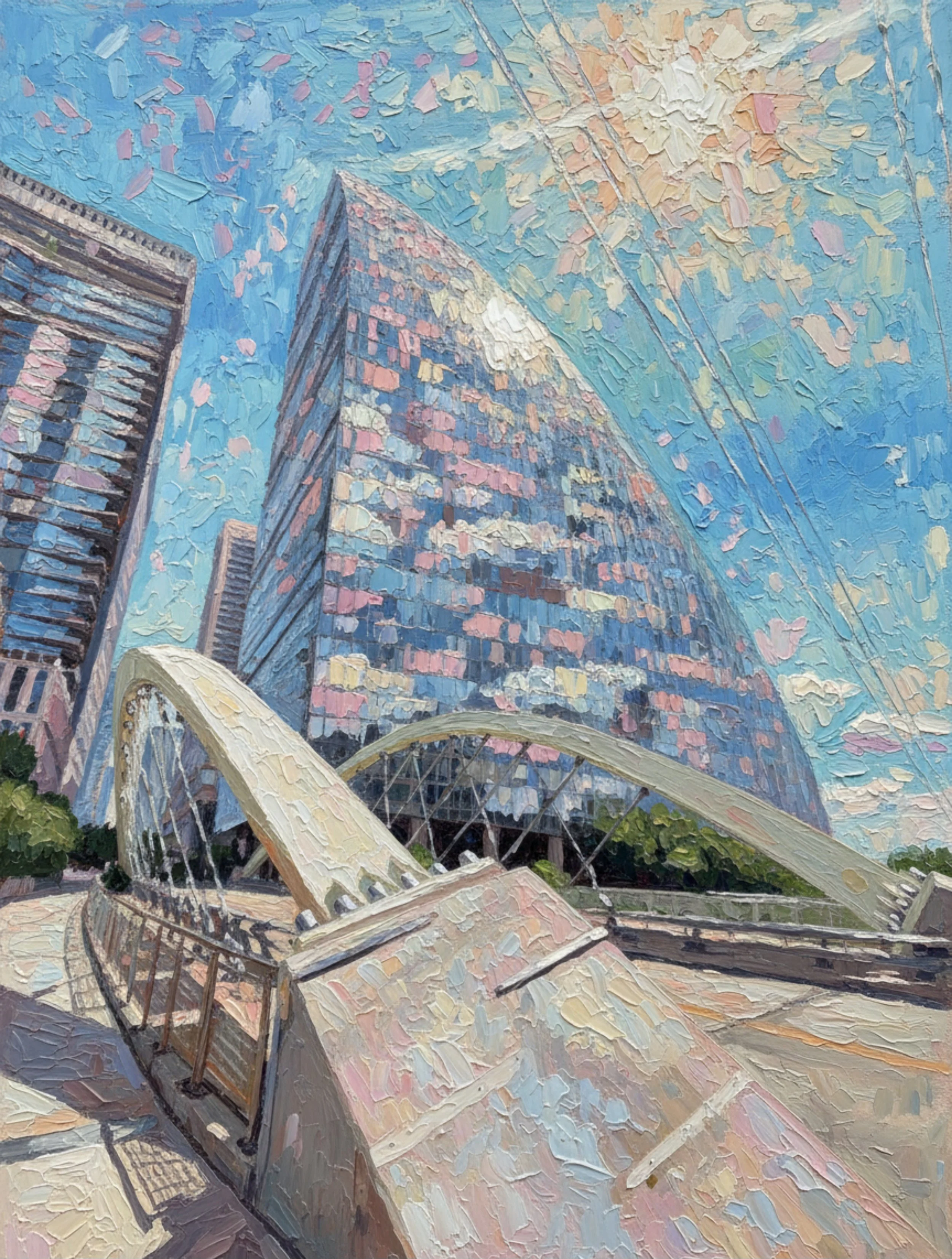
google sail building
The Urban Velocity
Back home, if you stepped outside in the morning, the air was thick with the honest, grounding scent of the pastures—the rich, heavy smell of manure, damp soil, and sweet, cut grass. It was a silence that felt completely unbroken. Here, the soundtrack and the sensory profile have shifted entirely. The morning air no longer carries the scent of the countryside. Instead, it is a hazy patch of limestone dust hanging in the bright sunlight. The low hum of livestock has been replaced by the sudden, sharp wail of emergency vehicles cutting through the grid—sounds rarely, if ever, heard in the quiet hamlet of home.
We have landed directly in the center of a historical collision. The 74-mile corridor stretching between Austin and San Antonio is actively being forged into a massive, integrated mega-hub—a sprawling metropolis mimicking the exact blueprint that fused Dallas and Fort Worth together decades ago. To truly understand the scale of this shift, you have to look at the numbers. The city of Austin proper just crossed a historic milestone, officially breaking past one million residents for the first time in history. Its wider metro area has swelled to 2.35 million people. Just down the road, the San Antonio metro footprint sits at 2.56 million. Together, this rising Central Texas mega-hub represents a collective footprint of over 5.5 million residents. Contrast that with the Greater Lansing area, which encompasses a comfortable, modest tri-county total of roughly 473,000 people. It is a massive, dizzying leap in human density.
Adjusting to this density means learning the distinct language of apartment living. You quickly become hyper-aware of the realities of shared walls, and you find yourself developing fiercely guarded favoritism over specific, coveted parking spots in the complex garage.
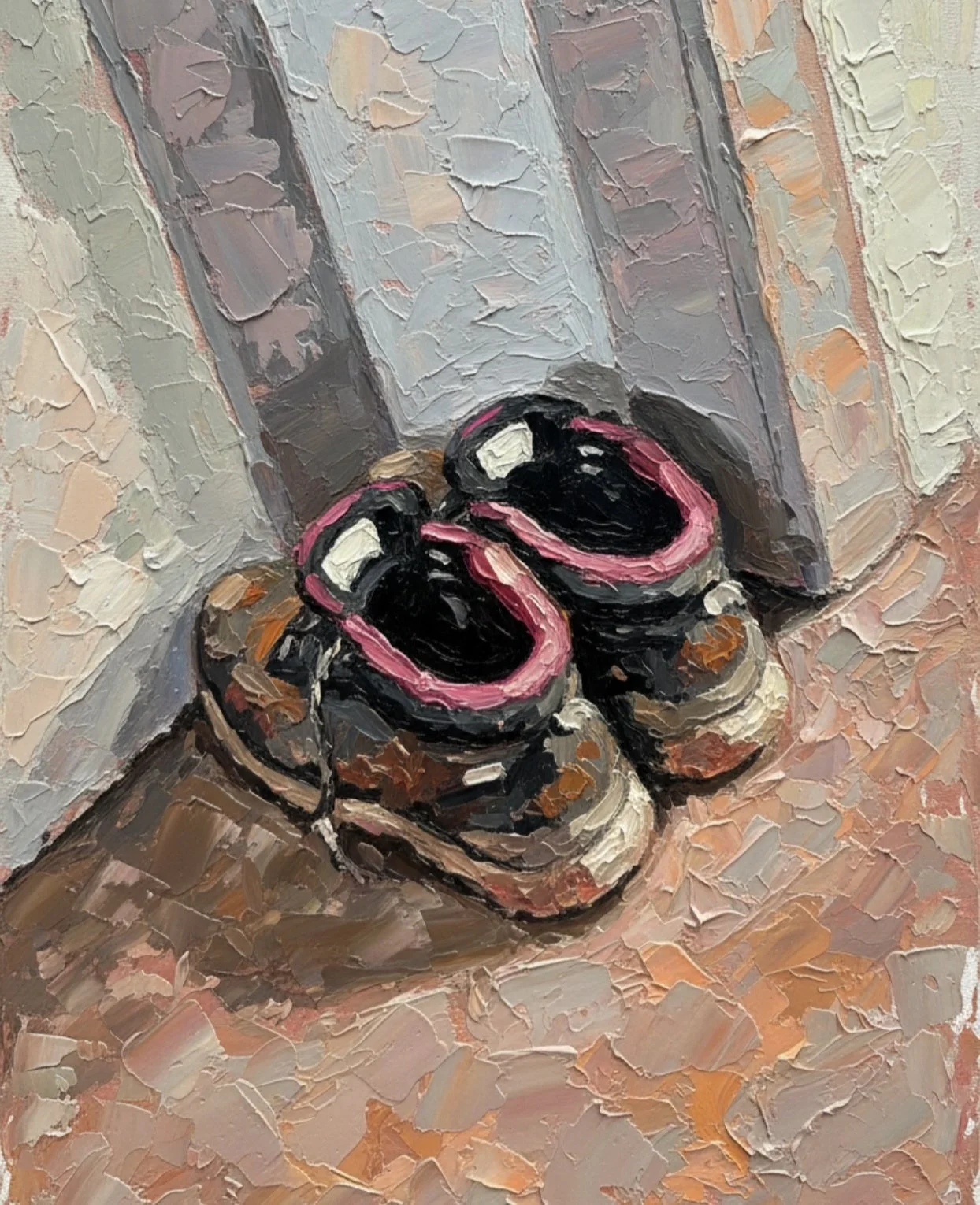
muddy shoes
Right now, that density has reached a fever pitch. With the Austin City Limits festival buzzing through town, a massive influx of over 75,000 people has converged onto the city grid all at once. The streets have transformed into a frantic choreography of pedicab bike carts zipping up and down the asphalt, pedaling furiously to earn as much as they humanly can while the crowds are thick, creating a whole new level of chaos on top of the already swollen car presence. Uber wait times routinely skyrocket past an hour. Everywhere you look, there are waves of visitors trying to frantically cram an entire lifetime culinary bucket list into a single weekend—crashing through 72 continuous hours of legendary barbecue, street tacos, local pizza, and everything else this city has to offer. By midnight, the festival venues have dissolved into massive mosh pits, and the aftermath travels straight back home with us—leaving a trail of tired, muddy boots littering our quiet community apartment hallways.
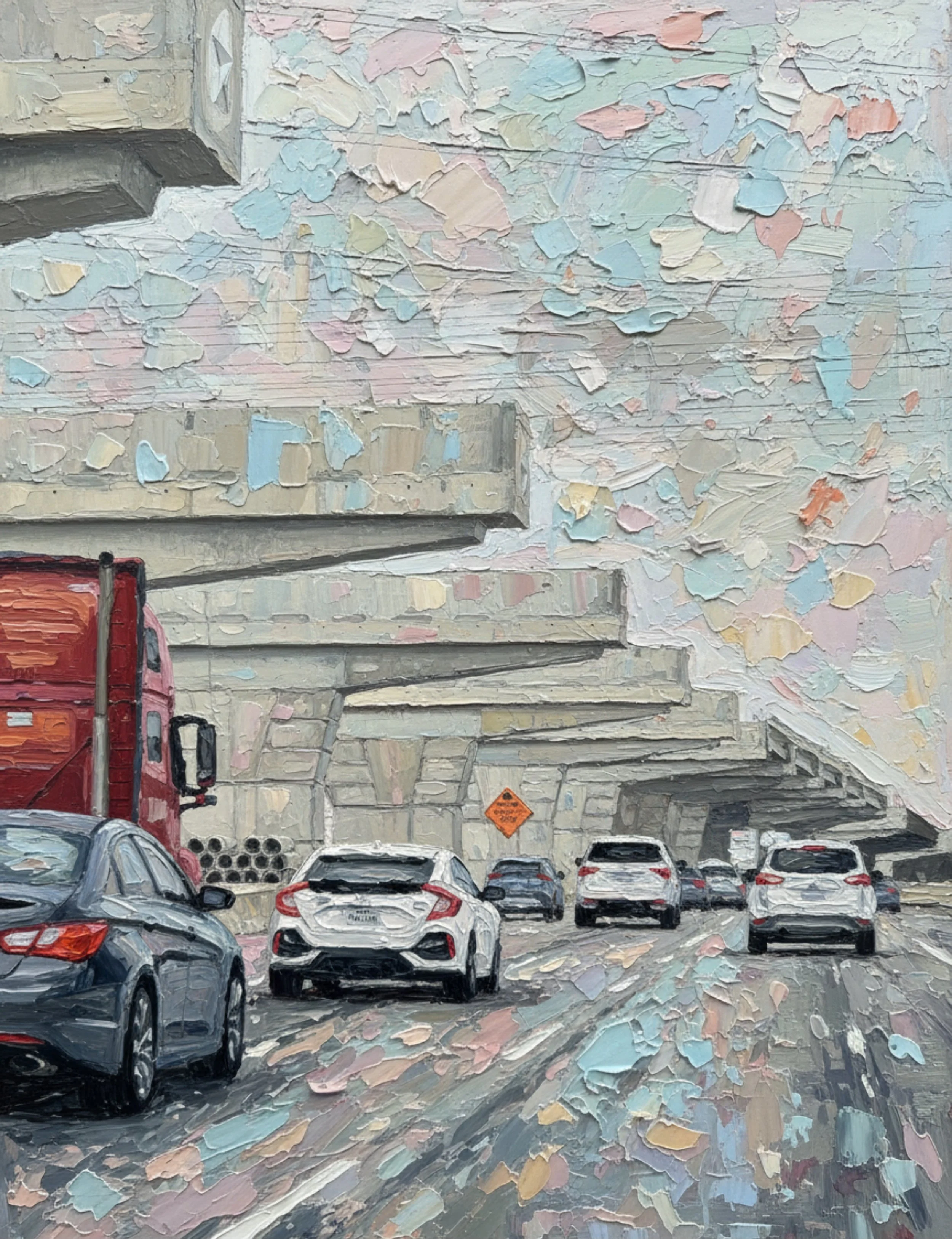
construction on the highway
Feeding and supporting this sheer volume of humanity is an unimaginable operational feat. Right outside our window, it is a ten-year reconstruction reality. The multi-billion-dollar CapEx project is physically tearing up and sinking Interstate 35 beneath downtown Austin, slated to run all the way until 2033. It is a symphony of progress—the rhythmic, mechanical thud of pile drivers striking steel, the deep rumble of diesel engines, and the grinding whine of saws cutting through stone. Even the raw construction infrastructure proudly wears the badge of Texas, with the iconic Lone Star cast directly into the massive concrete retaining walls and bridge abutments. To navigate it all, a sweeping network of high-speed toll roads stretches outward, boasting dizzying, elevated speed limits that make commute times shrink dynamically even as the city’s geographic footprint expands. The open pastures are giving way to the iron and stamped concrete bones of a near-futuristic city.
The near-futuristic rhythm extends even to the digital space. Sitting in our new space, pulling up an app to search for ideas for dinner reveals a dizzying matrix of options—literally hundreds of DoorDashable restaurants ready to deploy food delivery pods or autonomous vehicles to our door. Back home, DoorDash simply didn't exist. But even with a universe of delivery options at my fingertips, I am not a DoorDash person. I prefer the whole experience—the sights, the sounds, the atmosphere, and the dirt under the fingernails of a city.
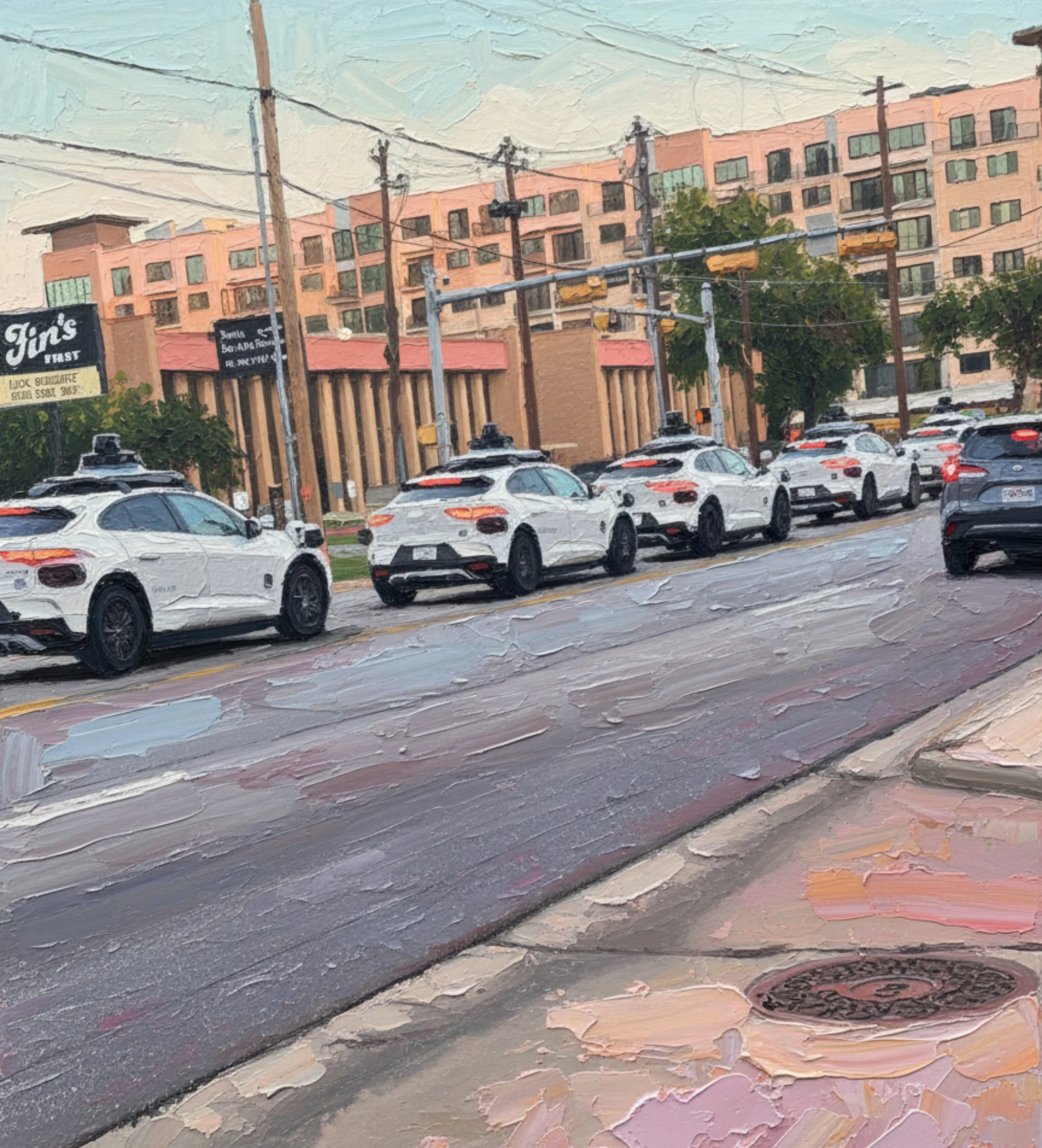
a line of waymo’s heading to the charging station
Weather You Can Wear
And yet, there is the density of the sun. Texas greets you with "weather you can wear"—a physical, heavy presence in the air that completely changes how you move. Your driving patterns rewrite themselves instantly; your parking strategy shifts from looking for proximity to looking purely for protection. Back in Michigan, a car might take twenty to thirty minutes on a warm day to reach dangerous internal temperatures of 115 degrees. Out here, a vehicle left in an open lot undergoes a near-instant greenhouse explosion—becoming a literal oven blasting past 130 degrees in a mere five minutes, eventually peaking closer to a blistering 150. I totally do that shade hunting in parking lots now—angling the car under the branches of a live oak or behind a concrete barrier to save our interior from baking. You learn to play the local shade-seeking matrix: shade first, distance second.
One night, sitting in our place after weeks of this relentless heat, I listened to the local weather forecast only to hear the meteorologist casually announce a brand new "heat warning." I looked at the screen and thought, Um... come again? Haven’t we been living in a continuous heat warning since the day we crossed the state line? The climate data actually backs up my sanity here: the city recently logged an absolute record-shattering stretch where 39 out of 43 consecutive days peaked at 100 degrees or higher. That means we spent a staggering 91% of our introduction to Austin baking in triple digits. We had been enduring such an oppressive streak that when the thermometer finally dipped down to a high temperature of 99 degrees for those remaining four days, the weather station officially claimed the streak was broken. I’m calling it right now: one degree less still absolutely counts as an active heatwave!
Using 100 degrees as a rigid milestone means you lose all endurance credit for a day that is still hot enough to melt asphalt. Because let's be honest—once you factor in the relentless Texas humidity and add in the heat index, those "relieving" 99-degree days were actually pushing a stifling, physical strain of 105 to 109 degrees on the body. It was DEFINITELY over 100 degrees all day long!
In this environment, your skincare game faces a monumental trial. My makeup lineup is Jones Road, and honestly, even Bobbi Brown is not remotely prepared for this kind of intense environmental gauntlet! (But I still love you, Bobbi!) Your makeup better be thoroughly water-tested before you step out the door. And if you are wondering if the relentless Texas humidity affects your hair the way it does mine? You have my deepest, most sincere condolences. I'm just waiting for the local news to drop its next favorite warning: the arrival of the infamous winter "Cedar Fever". It is a world away from typical Michigan weather. Heading straight into the autumn with daily temperatures stubbornly clinging to the high 80s forces you to look at the horizon and realize: you’re not in the Mitten State anymore, Toto.
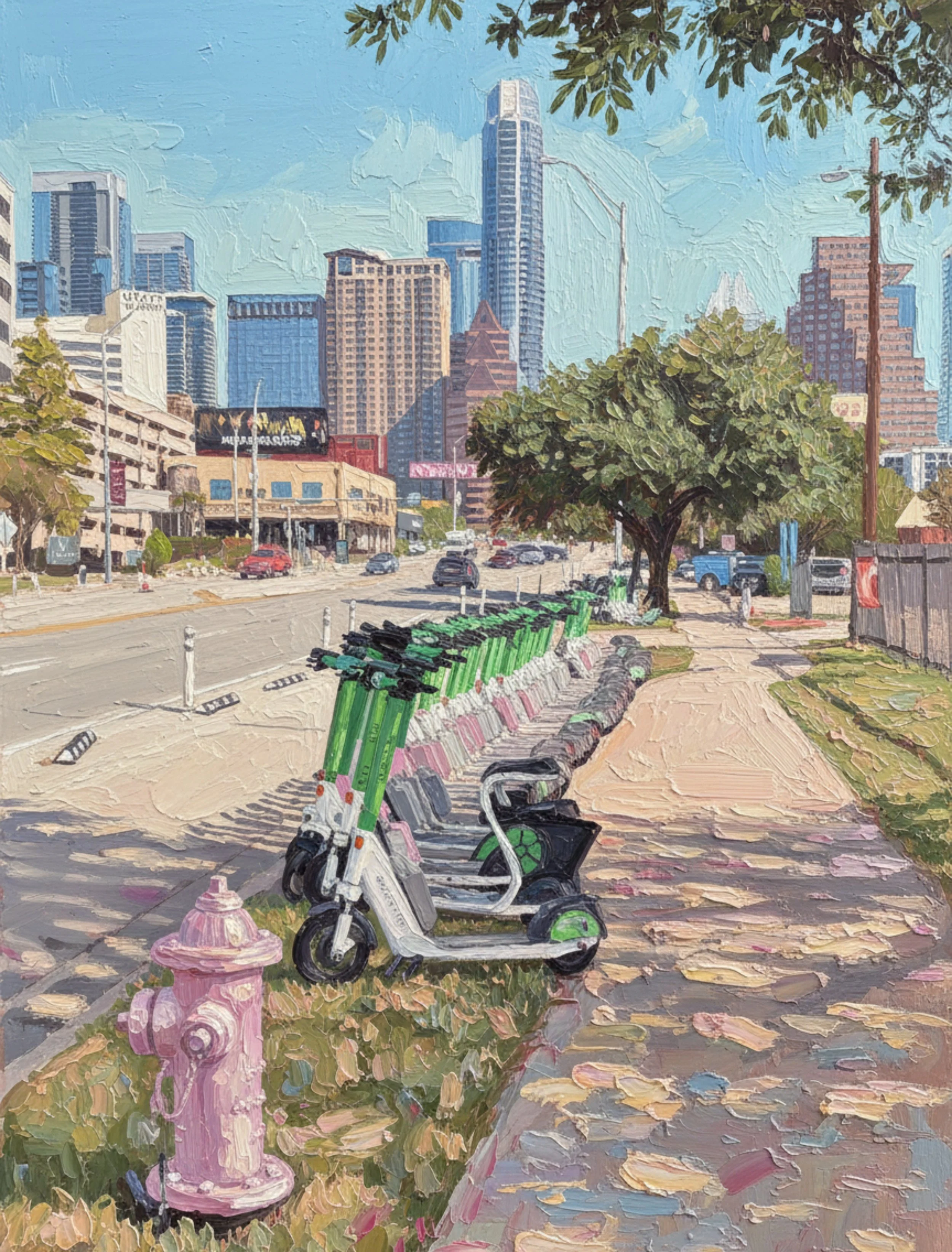
Yet despite the heat, this is a fiercely dedicated walking city—and a running city. People are constantly out pounding the blazing pavement in the middle of a triple-digit afternoon, displaying the kind of intense athletic cardio that I would personally require a massive grizzly bear chasing me to encourage. Seriously, out here, RUN-NING in hundred-degree weather is the absolute epitome of what keeps Austin weird. To survive it, the daily wardrobe shifts entirely to activewear during the daytime hours. When you do spot western wear on the streets, it’s rarely a full cowboy aesthetic; instead, it is a curated fashion statement—usually knee-high boots worn by stylish new transplants navigating the blocks. If your own daily commute outstretches the capability of your legs, the sidewalks are littered with rentable electric scooters and pedal-assist bikes to bridge the gap. Coffee shops and specialty roasters are tucked into nearly every single corner to keep the whole machine caffeinated.
But for me? I have implemented a strict boundary. I have a maximum limit of about one mile each way that I am willing to travel for food by foot when the weather is in near proximity to 100 degrees. Because out here, you have to remember the return trip is going to be absolutely brutal. Austin’s Law: What goes out, must come back.
Because of this constant warmth, the profound lack of rain has been deeply significant since our arrival. I have only witnessed two brief, true bouts of rainfall, with this last weekend dropping a rare, heavy blanket of overcast gray over the hills. The first time the skies finally opened up, it felt like a communal phenomenon. I watched from the safety of the glass as the downpour drummed loudly against the hard surfaces outside. Looking out, it was clear I wasn't the only one recording the event—half the neighborhood was standing on their patios doing the exact same thing, documenting the falling water like a long-lost friend.
Watching the deluge, I couldn’t help but wonder what a sudden storm does to an afternoon commute here. It’s not just the highway grid that feels vulnerable; the city streets themselves visibly struggle to keep up with basic drainage, a clear sign that this infrastructure is simply not familiar with handling bad weather. But looking around at the traffic, the lack of moisture reveals a beautiful silver lining. I saw a pristine 1980s Toyota cruising down the street today, looking like it had just rolled off the showroom floor. Everywhere you look, there are vintage vehicles that resemble our own in age, driving around with absolutely not a single trace of rust or northern salt damage on their frames.
The Convergence
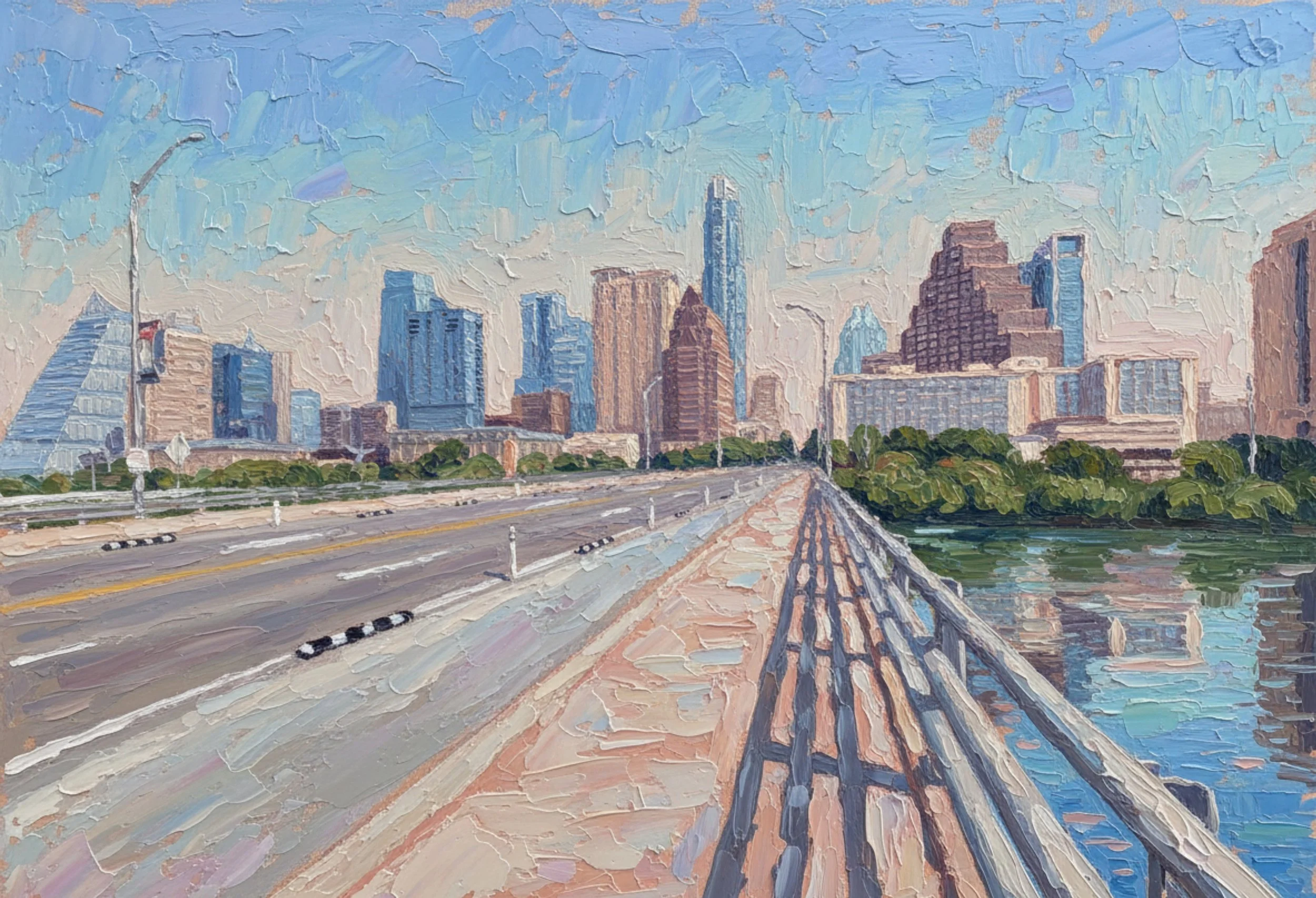
congress street bridge with water view
But when the clouds break, everything in this city ultimately converges down on Lady Bird Lake. The absolute lifeblood of the downtown landscape, its legendary water is framed by a massive, interconnected walking and biking loop that stretches for ten full miles along the banks. Peering over the water, the surface is a constant choreography of activity. There are electric rental skiffs, whimsical swan pedal boats, and dozens of people balanced precariously on those long, floating boards, paddling their way down the current standing up. Look a little closer beneath the wake, and you’ll find a completely different pace of life—scores of native turtles sunning themselves along the half-submerged logs or floating silently just beneath the surface.
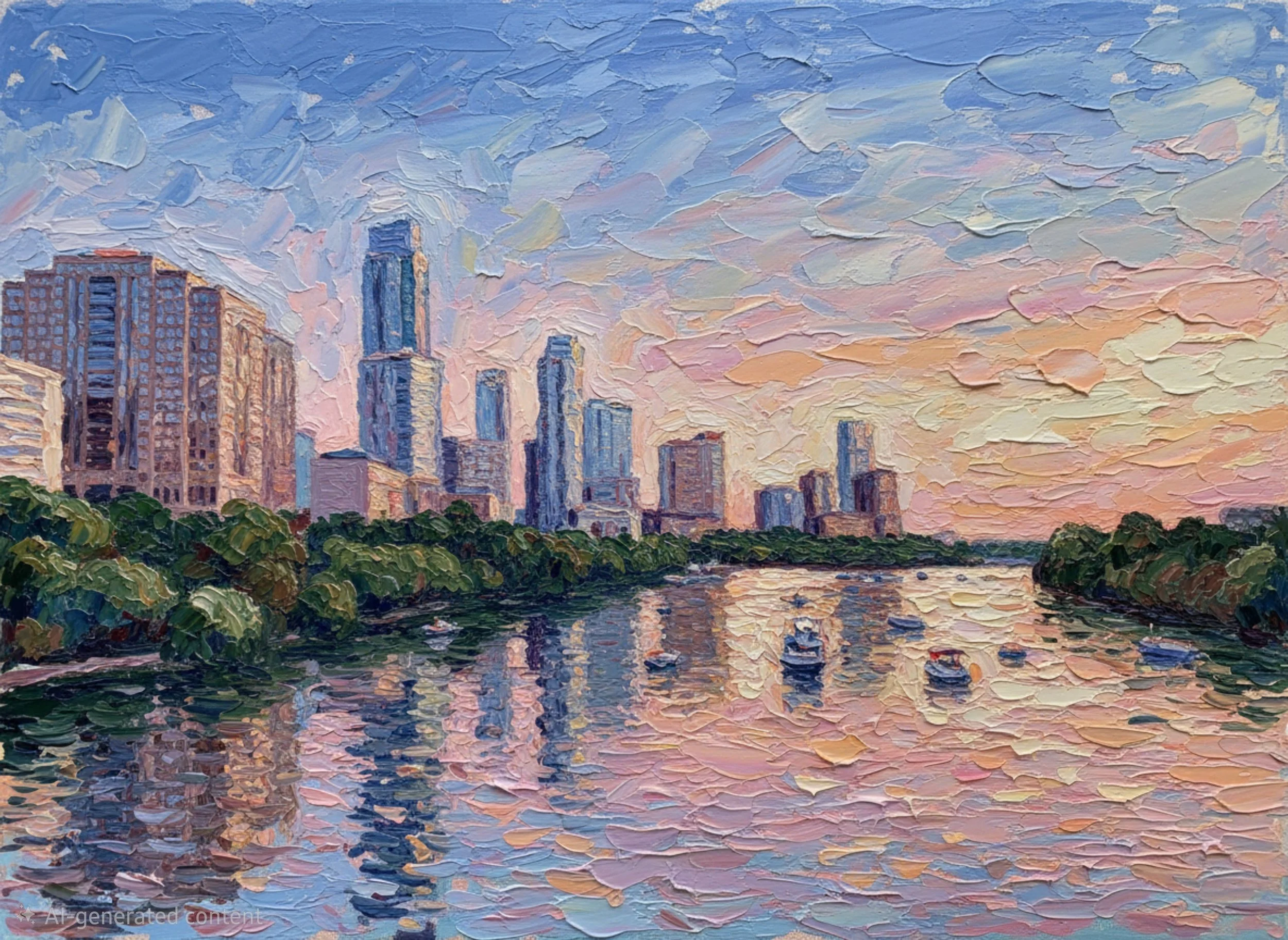
boats on lady bird lake at sunset by downtown austin
This energy bleeds directly off the banks and into the urban center, a paradise of continuous culinary exploration boasting hyper-dense downtown food halls, an expansive, late-night food truck culture, and a buzzing network of 24/7 coffee shops catering to the massive student population keeping watch nearby.
We aren't just tracking a journey on a map anymore. As night falls, the hum of the construction cranes begins to quiet, replaced by the brilliant, neon glow of a tech empire reflecting off the dark water of the river. The evening air fills with the sounds of a city beginning its nighttime routine—the low rumble of traffic crossing overhead, the murmurs of walkers finishing the trail, and the low, glowing tour boats idling underneath the famous bat bridge, waiting for the sky to turn. Looking out over this vast expanse from the stillness of our window, the scale no longer feels intimidating—it feels like an invitation. We are watching a new world build itself right in front of us, one ray of sunlight, one drop of rain, and one incredible mile at a time.
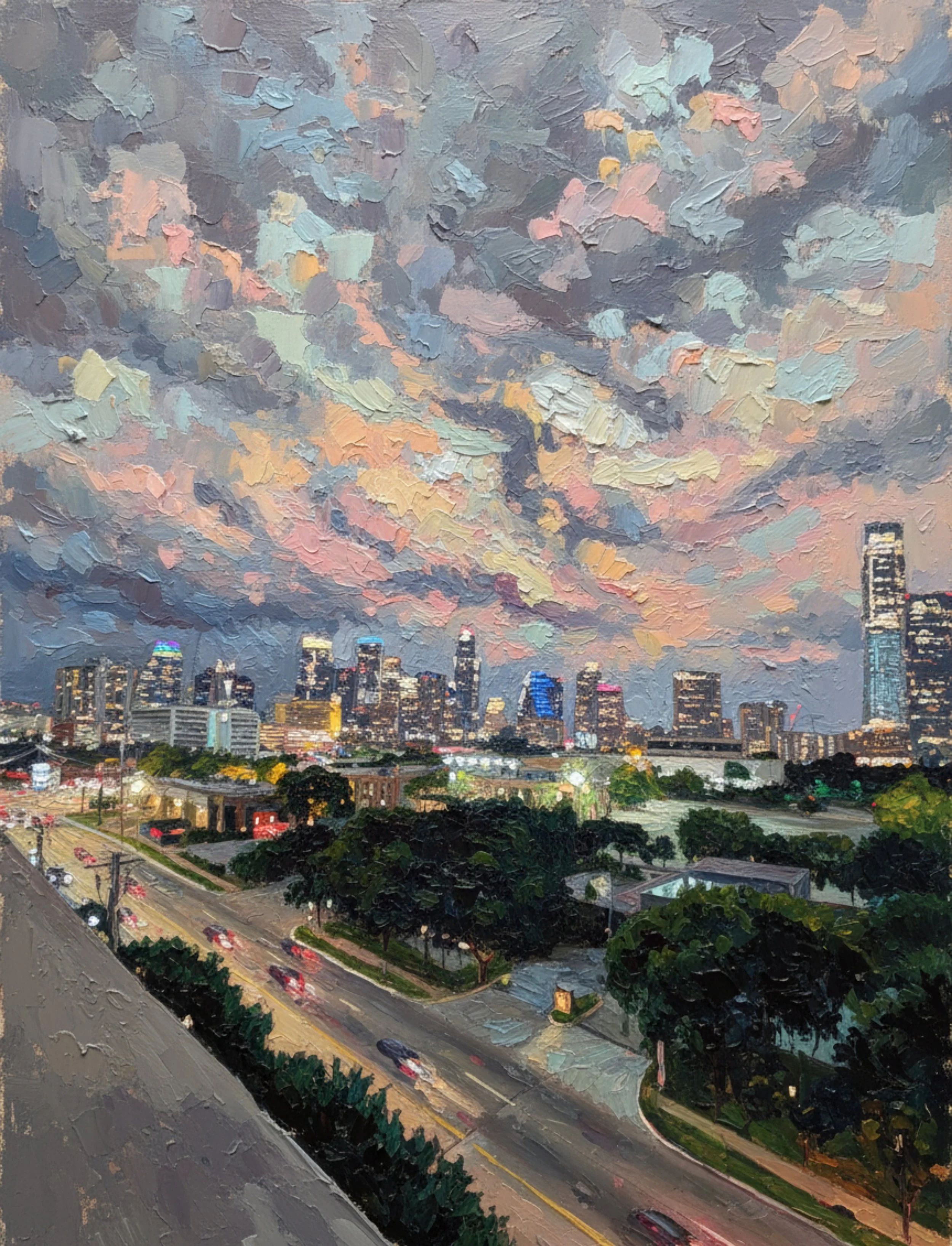
night time skyline view
This energy bleeds directly off the banks and into the urban center, a paradise of continuous culinary exploration boasting hyper-dense downtown food halls, an expansive, late-night food truck culture, and a buzzing network of 24/7 coffee shops catering to the massive student population keeping watch nearby.
We aren't just tracking a journey on a map anymore. As night falls, the hum of the construction cranes begins to quiet, replaced by the brilliant, neon glow of a tech empire reflecting off the dark water of the river. The evening air fills with the sounds of a city beginning its nighttime routine—the low rumble of traffic crossing overhead, the murmurs of walkers finishing the trail, and the low, glowing tour boats idling underneath the famous bat bridge, waiting for the sky to turn. Looking out over this vast expanse from the stillness of our window, the scale no longer feels intimidating—it feels like an invitation. We are watching a new world build itself right in front of us, one ray of sunlight, one drop of rain, and one incredible mile at a time.
When you have traveled or moved…what changes do you notice most?
I'd love to hear from you.
Your stories, shared here, become part of the gathering.
~Miche,
in the meantime, I will be in the still
…gathering.
aevaura is time and presence.
Let's gather what endures.
